
In the words of that esteemed philosopher and New York Yankees baseball catcher in the 1940s, 50s and 60s, Yogi Berra, ‘It’s like déjà vu all over again.’
My last visit to a lunchtime concert at Dewsbury Town Hall was to see ‘Baritone, Soprano and Piano’ during which we were treated to a vocal version of the fourth movement of Schubert’s Trout, a piece in five movements originally written for a quintet. Today we got the full monty, and it was superb.
The work follows a stroll through the Austrian countryside on a summers day, although the music could be the soundtrack to an amble in any country when the sun was out and the mood laid back. Because the movement which gives its name to the whole work is written as a variation on a previous lied (song) we were given a rendition of the words – in English – by David Cowan, Opera North’s Head of Music, who said that he would recite them in order to spare us from his singing, whilst Byron Parish played the melody on violin.

The gist is that the poet stops at a stream during his walk when he sees a trout languishing in the clear shallows, and an angler doing his best to catch it. The spectator knows that as long as the water is clear, the prey can see what is happening and is quite safe. At this point the music is calm and flowing like the brook. The angler, being aware of this, decides that his best recourse would be to drag his waders through the bed and muddy the waters, which he did, and, sure enough the rod twitched and the trout went from being on the bottom of the stream to being on that night’s menu.
At this point the music takes a dramatic turn to reflect the tussle but reverts to its flowing mode when the mud is slowly washed downstream and the waters once again run clear.
The end of the poem, which I have shamelessly paraphrased, compares this contest to the seduction of girls by boys and urges the former to hurry away when they see danger from the later, before they suffer the same fate.
You can hear this movement, minus the words, by clicking on the link below. I am sure it will be familiar to a lot of you, but even if it isn’t it is a very accessible passage and makes a good soundtrack to your reading the rest of this article.
Schubert dispensed with convention when he wrote this and scored it for piano, violin, viola, cello and double bass, rather than piano and string quartet. The double bass certainly adds drama to the fishing episode.
In addition to Byron Parish, mentioned above, on violin, David Cowan took to the piano after his poetry recitation, and we had Anne Trygstad on viola, Lydia Dobson, cello and Roberto Carillo, double bass. All members of the Orchestra of Opera North.
So, another extremely pleasant lunchtime at Dewsbury Town Hall where, fortunately, the fish sandwich option was tuna and not trout.
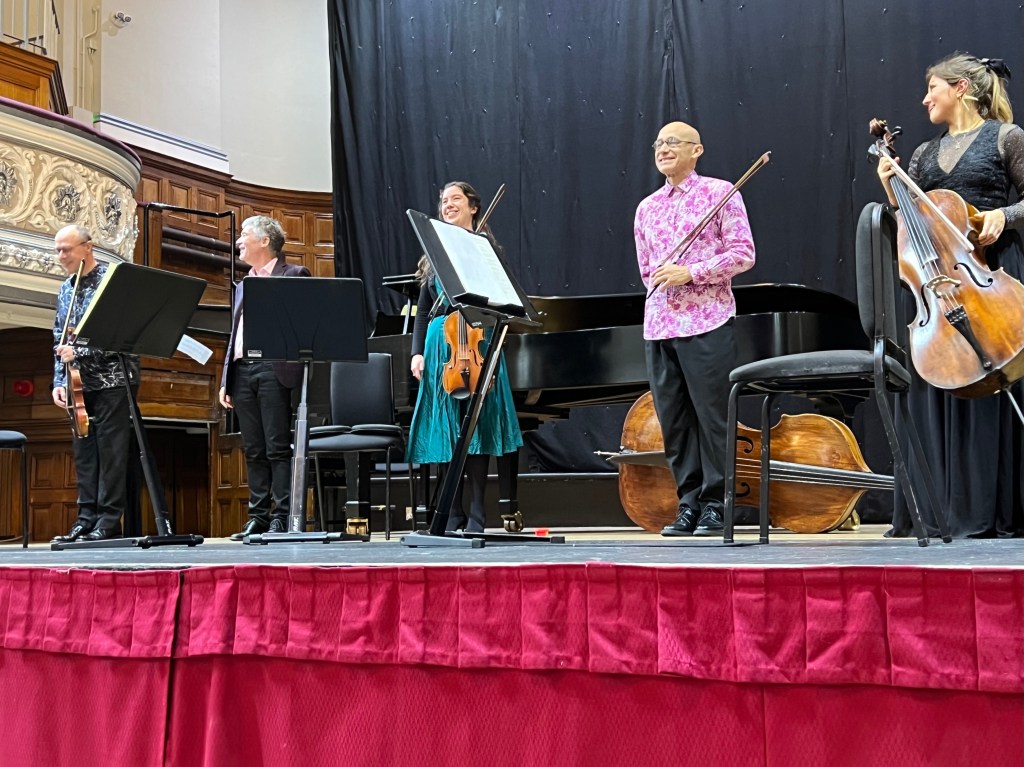
The Quintet from left to right; Byron Parish, David Cowan, Ann Trystad, Roberto Carillo and Lydia Dobson.
I began with a quote from Yogi Berra, however, I must add a caveat. He was so prone to making nonsensical statements, but which somehow worked, that there were many attributed to him even though they had never passed his lips. As he so thoughtfully informed us (maybe), ‘I really didn’t say everything I said.’
To see the full programme of concerts at Huddersfield and Dewsbury please go to https://www.operanorth.co.uk/news/location/huddersfield-dewsbury/
For all Opera North’s programme it is https://www.operanorth.co.uk/
All photographs by Stan Graham
 Tyke It To The Limit